The idea
A fixed solar panel only collects its best output for part of the day. This project builds the sensor and control layer for a tracker: four light-dependent resistors arranged as a quadrant sensor, an Arduino Uno to compare the readings, and a dual-axis motor drive that turns the panel toward the brighter side.
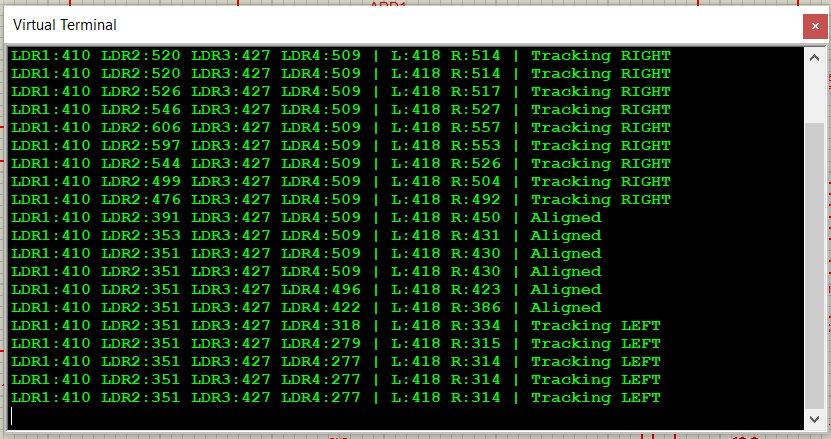
The design was built and tested in Proteus first, with a virtual terminal standing in for the I2C display because the display model does not run in the simulation. That kept the circuit and firmware testable before anything was soldered.
Sensing
Each LDR sits in a 10 k voltage divider, so the analogue input rises as that quadrant gets brighter. The firmware samples all four channels, compares opposite pairs, and only moves an axis when the difference exceeds a threshold of 40 counts out of 1,023. The dead band stops the tracker from hunting on a slightly uneven sky.
The four sensors are mounted in a cross with an opaque divider between them. That geometry matters more than the code: it turns a set of absolute light readings into a direction estimate, and it lets the same firmware work under different overall brightness levels.
Motion and safety
An L298N dual H-bridge drives two 12 V DC motors, one per axis. PWM is held at 150 out of 255 for a controlled slew instead of a slam to full speed. Limit switches on each axis stop the drive before it can over-travel, and the firmware releases the bridge whenever no movement is required.
The loop runs every 300 ms. That is slow enough to filter cloud flicker and fast enough to follow the sun without noticeable lag, and it keeps the motor current and supply droop manageable on a small bench supply.
What the simulation showed
The Proteus model confirmed the comparator logic and the motor direction table before assembly: shading one quadrant drives the correct axis in the correct direction, and the limit switches cut the drive when the model reaches its end stop. The display shows the four channel values and the current axis state for tuning.
The next step is a mechanical build with a panel load, current sensing and a proper charge controller, so the tracker can be judged on energy collected rather than on how neatly it points.
Figures